Frost, Sugars and Shelf Life: A Canny Guide to Late-Autumn Grass Botanicals
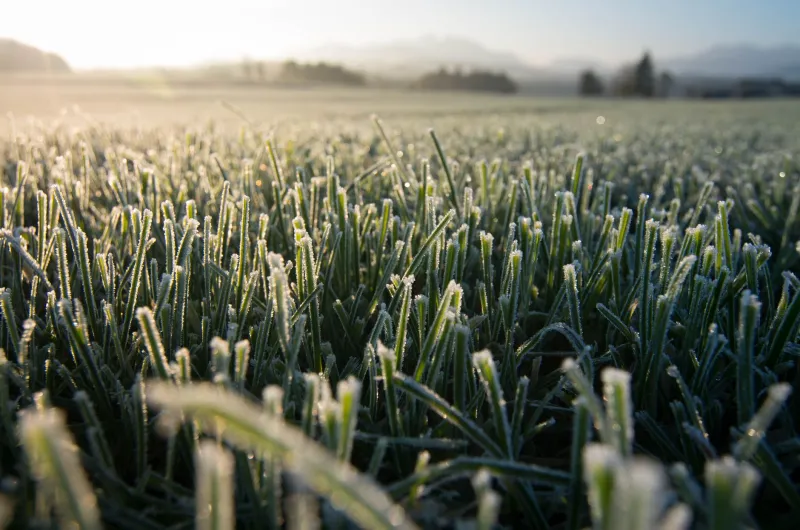
The first proper frost of the season tends to arrive in the UK with very little ceremony. You notice it on the allotment path before you notice it on your face: the grass goes stiff and pale, the water butt has a skin of ice, and the nettles finally stop pretending they are still in business. It is a useful moment to talk about what a cold snap does to grass botanicals — and what it does not do.
Here at Grass Skincare, we are wary of turning frost into a marketing event. A plant that has been through a cold night is not automatically a superior skincare ingredient. But something does change in the field, and that change is worth understanding if you are buying late-autumn formulas or trying to make sense of a label that mentions harvest dates.
What a cold snap actually does to a grass plant
When temperatures drop, plants start adjusting their internal chemistry. Sugars can rise as part of cold acclimation — think of them as a kind of internal antifreeze — and the balance of organic acids and other compounds can shift too. Antioxidant levels may move in either direction depending on the species, the timing of the frost, how soon the crop is cut and how it is dried or extracted.
That is the important bit: there is no single 'frost effect' that applies to every grass botanical. Barley grass, wheatgrass, oat, nettle and the broader meadow plants we lean on in British skincare all behave differently. A light frost may barely register in one crop and visibly knock back another. A hard, prolonged freeze can damage cell walls and speed up chlorophyll breakdown, which is why late-cut green powders can look duller and taste more grassy than sweet.
So when a label says 'frost-kissed' or 'first frost harvest', the useful question is not whether it sounds romantic. It is whether the maker can tell you what they measured, when the crop was cut and how quickly it was stabilised. Without that, 'frost' is just weather.
Reading harvest dates without the fairy dust
Harvest dates on skincare are a bit like best-before dates on bread: helpful, but only if you know what they refer to. A date printed on a jar might be the harvest of one key extract, the date the product was blended, or the end of its shelf life. Those are three very different things.
For British grass botanicals, late-autumn harvests are not automatically better or worse. Some crops are deliberately cut earlier to capture a particular profile; others are harvested later because that is when the plant is available. If a brand is selling a limited late-autumn batch, ask what is actually different about it. Higher sugar content can affect taste and how a powder behaves in water, but it does not guarantee a better skincare result. Lower antioxidant activity after a hard frost is also possible, especially in water-based extracts that have not been carefully protected.
Storage advice matters just as much as harvest talk. Powders should be kept cool, dry and away from light. Water-based mists and serums need to be treated as fragile — a bathroom windowsill in winter is a terrible place for them, because the temperature swings every time someone has a shower. If a product contains a fresh-ish grass extract and no robust preservative system, it is not a bargain; it is a countdown.
The practical bit: chapped skin and central heating
By the time we are deep into winter 2026, most of us are dealing with the same combination: cold wind outside, dry radiator air inside, and hard water in plenty of UK homes. That is a recipe for tight cheeks, rough patches around the nose and hands that feel like sandpaper. It is not the moment to pile on every grass active in the cupboard.
A sensible adjustment is to reduce the number of steps that strip the skin and increase the ones that support the barrier. If your skin is already chapped, a creamy cleanser or a simple rinse in the morning is often kinder than a foaming wash. In the evening, use a gentle cleanser and follow with a moisturiser that contains familiar barrier ingredients — oat, shea, glycerin, squalane — alongside any grass botanical you are curious about. Keep exfoliation to a minimum, and do not chase a tingle.
Grass extracts can still earn their place. Nettle and oat-based ingredients are useful in calming, hydrating formulas, while barley grass and wheatgrass powders are better kept for products where the formulation is designed around them. The key is not to expect a frost-affected plant to do more than a well-made moisturiser.
A simple late-autumn swap
If you want a low-drama routine shift for the colder weeks, try this. In the morning, rinse with lukewarm water or use a cream cleanser, apply a hydrating mist if you like them, then a barrier-friendly moisturiser and SPF. In the evening, double-cleanse only if you have been wearing heavy sunscreen or makeup; otherwise one gentle cleanse is enough. Use a grass-botanical serum two or three evenings a week rather than every night, and seal it with a slightly richer cream on the areas that chap most — nose, cheeks, chin.
Store your products in a cool cupboard rather than the bathroom shelf. Check the batch code and any harvest note, but do not treat either as a magic spell. And if a product claims that frost has 'activated' its ingredients, ask for the evidence. In skincare, as in gardening, the most reliable results come from steady habits rather than dramatic weather.