Your Blender Is Not a Laboratory: The Case Against the Jam-Jar Green Water
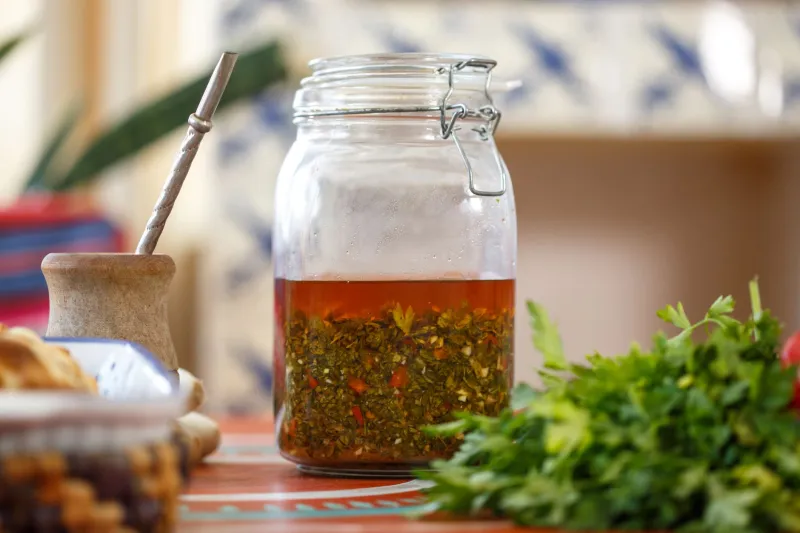
There's a particular video format that keeps resurfacing in my feed. A handful of lawn clippings goes into a blender. A few nettle tops follow, maybe a dandelion leaf or two, a splash of tap water, and thirty seconds of motor noise later a strained green liquid is being decanted into a repurposed pump bottle. The caption usually says something about 'lawn medicine' or 'free skincare'. The comments ask for the recipe.
I understand the appeal completely. It costs nothing, it smells like a garden in June, and there's a real, quiet pleasure in making something from what the mower left behind. The ritual is lovely. It's the storage that worries me.
What is actually in that jar
When you blend a lawn, you aren't just extracting grass. You're extracting everything that was sitting on the grass.
Start with the obvious one: lawn treatments. Weed-and-feed granules, moss killers containing ferrous sulphate, selective herbicides and the occasional slug pellet all leave residues on leaf surfaces, and those residues don't politely evaporate on a schedule you can predict. Blending a large volume of clippings into a small volume of liquid concentrates whatever was on them. The same goes for verges and playing fields, where you have even less idea of what has been applied and when.
Then there's the animal traffic. Dog fouling on parks, footpaths and the strip of grass outside the school gate is common, and the roundworm eggs that come with it are remarkably sturdy. You are not going to see them. Nor will you see the soil bacteria — Pseudomonas, Bacillus, various Clostridium species — that come along for the ride on anything grown close to the ground, or the mould spores, or the aphids and thistle down and the pollen load that makes a blended lawn look so vividly green in the first place.
And if your foraging loop takes in a roadside verge, add tyre and brake particulate to the list. It's not a reason to panic about living in a city. It is a reason not to paint it on your cheeks.
The preservative question nobody answers
Here is the part that turns a charming kitchen project into a genuine risk. A green water is water plus plant material plus sugars plus minerals, at roughly neutral pH, in a warm room. That is a growth medium. It is not far off what you'd deliberately mix up if you wanted to culture something.
Commercially made botanical waters get a preservative system — phenoxyethanol, benzyl alcohol, sodium benzoate, often paired with a chelator and a pH adjuster — and then they go through a formal challenge test, usually to ISO 11930, where the formula is deliberately inoculated with bacteria, yeast and mould to see whether the preservative holds. Your jar has had none of that.
In practice the timeline tends to look like this. Day one, probably fine. Day three, questionable. Day ten, there's something growing near the neck of the bottle that you'd rather not identify. Keeping it in the fridge slows this down; it does not sterilise anything, and a cold jar of plant slurry is still a jar of plant slurry.
Spray bottles make it worse. Every pump draws air and any contamination on the nozzle back into the liquid, and every mist sends whatever is in there into the air around your face, and therefore towards your eyes and your airway.
The uses I would genuinely defend
I'm not going to pretend every homemade green thing is reckless. There is real low-risk ground, and it's defined by one rule: use it once, use it immediately, then bin what's left.
A cold poultice is the classic example. Bruised plantain or nettle wrapped in a clean cloth, pressed onto intact skin for ten minutes, then discarded along with the bowl and the cloth into the wash. A bath soak is similar — a muslin bag of fresh clippings hung under a running hot tap, then taken out and thrown away. A bath is a single-use, heavily diluted, down-the-drain situation, which is about as forgiving as plant material gets.
What I'd steer clear of is anything that sits: a labelled bottle on the shelf, a jar passed to a friend, a spray kept in the bathroom cabinet, a 'toner' used morning and night for a fortnight. Add eyes, broken skin, eczema flares, children and anyone immunocompromised to the no list, and you've covered most of it.
Where UK law actually draws the line
The rules here are less mysterious than people assume. Cosmetics placed on the UK market fall under the retained EU Cosmetics Regulation, and that regulation governs 'making available on the market' — a phrase that includes supplying a product free of charge in the course of a business. Once you're inside that definition you need a Responsible Person, a Cosmetic Product Safety Report, a Product Information File, good manufacturing practice, compliant labelling with an ingredient list, batch code and period-after-opening, and a notification via the UK Submit Cosmetic Product Notification service.
That is why 'I'm only giving them away' is a weaker defence than it sounds. Blending up a few jars for a friend's birthday is one thing, and it sits well outside any commercial activity. Making them for a salon's clients, or handing them out to promote a market stall, or selling them at a village fête, is squarely inside it — and the fact that money didn't change hands doesn't move you out of scope. Local authority trading standards enforce this, and your home insurance almost certainly won't be expecting it.
If you want the ritual without the gamble
The compromise is simpler than it looks. Grow a tray of grass or herbs in a pot you fully control — no feed, no spray, no passing dogs — harvest in the morning, and use the infusion within the hour. Or take the water out of the equation entirely and dry your botanicals, because a dry herb is a far more stable thing than a wet one. Or buy a properly preserved green water and spend your kitchen energy on something with a longer shelf life and a challenge test.
The lawn is a great place to sit in November, and a genuinely nice source of material for a one-off soak. It is a poor place to manufacture skincare. Keep the ritual, keep the blender, but don't keep the jar.